
· by Michael Blair, Nashville's Masonry
Sealing brick gets recommended as routine protection, yet the National Park Service’s brief on cleaning and water-repellent treatments for masonry counts the wrong cleaning and coating treatments among the major causes of damage to old brick buildings. Whether a product helps depends on what it is and on understanding that a brick wall is designed to get wet and then dry out again.
How is a brick wall supposed to handle water?
Brick and mortar are porous by design. A masonry wall takes on water when it rains and gives it back as vapor while it dries, and the joints are meant to be the easy way out. The Park Service’s brief on repointing mortar joints explains that moisture in a traditional wall moved through the mortar rather than the brick, and that a mortar which will not let moisture or vapor escape pushes the damage into the brick itself.
Water also arrives from inside. Preservation Brief 39, on controlling unwanted moisture, describes humidified indoor air working out through walls toward a colder exterior, and the reverse in hot, humid weather, when moist outdoor air pushes in toward air-conditioned rooms. A house here lives through both in the same year, so the brick has to pass vapor in either direction, and anything that blocks it changes how the whole wall behaves.
What a film sealer does to it
Brief 1 separates two products that get sold under the same word. A water repellent, which it says is often called a sealer when it should not seal at all, is meant to let vapor through. A waterproof coating seals the surface against liquid water and water vapor alike, and the brief puts bituminous coatings and some elastomeric paints in that group. Water still gets into a coated wall, at the mortar joints, at the top, around windows and from behind, and now it cannot leave. One photograph in Brief 39 shows a parapet that partly failed after a waterproof coating held in the water from a leaking roof.
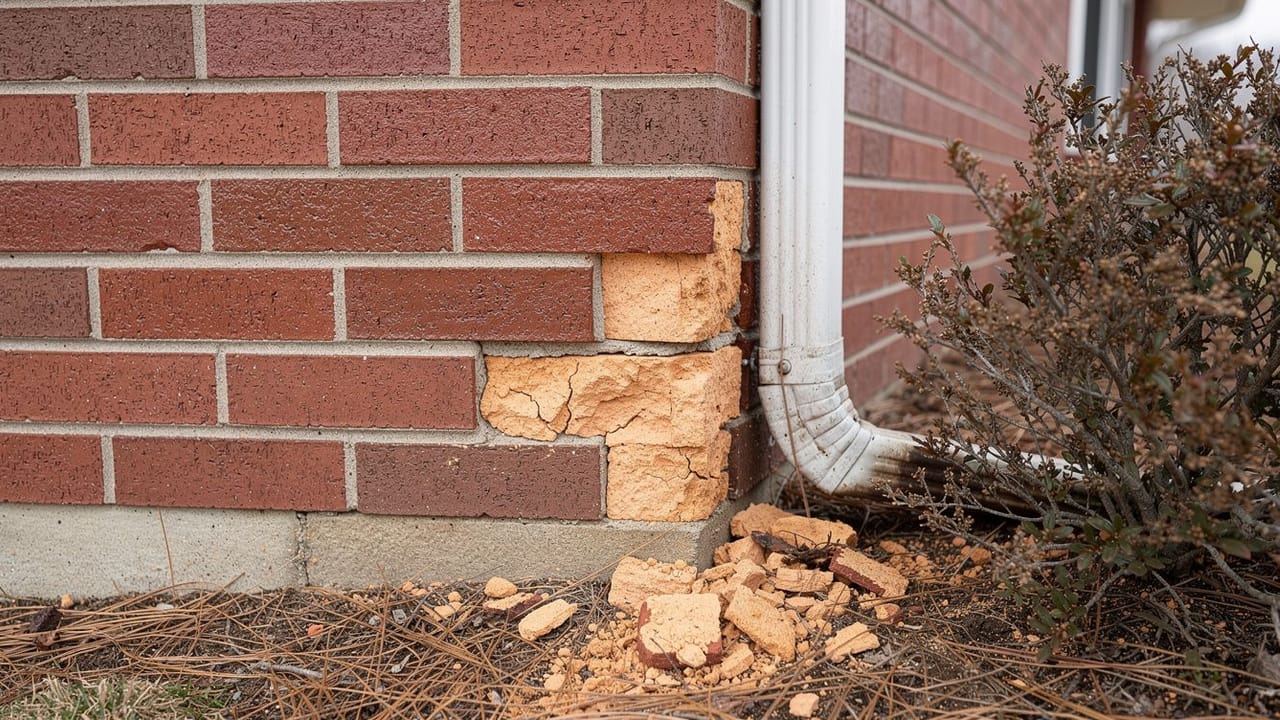
Trapped water freezes, and it gets plenty of chances here. The 1991–2020 normals NOAA publishes for the Nashville airport weather station show about 66 days a year with a low at or below 32°F, spread from October to April, against only about six days a year that stay below freezing all day, so most of those cold nights follow a thaw. Brief 2 shows a wall where moisture that could not evaporate built up pressure until it popped the faces off the bricks, and Brief 1 adds salts crystallizing just under the surface as a second cause, made worse when a coating slows the moisture leaving. That kind of damage cannot be repaired easily, and in practice it usually means cutting the brick out and replacing it, as our post on brick faces popping off describes.
- Waterproof coatings and some elastomeric paints trap vapor in the wall
- Water held under the face plus repeated freezing nights causes spalling
- A spalled face is hard to repair and usually means a new brick
- Even breathable silane and siloxane repellents slow vapor down
- No sealer fixes water entering through failed mortar or flashing
What, if anything, should go on brick?
If anything goes on the brick, it should be a penetrating water repellent and never a coating. According to Brief 1, most modern repellents are water-based and made from modified siloxanes, silanes and related compounds, and they soak slightly into the masonry instead of sitting on it as a film. They pass more vapor than the old coatings did, but the brief is plain that they still lower the wall’s vapor permeability, and that vapor condensing to liquid at a cold spot inside the wall cannot get back out through one. Applied properly they are almost invisible, though some darken certain brick or leave it glossy, and if one fails or discolors it can be close to impossible to remove.
Even that is not a default. Brief 1 considers a repellent only after the building has been made watertight and given time to dry out, only if water is still coming through the repaired walls, and then in selected areas with a conservator’s advice, never over the whole exterior and never on a damp wall. Soft, underfired brick from the 18th and early 19th centuries is the one case it singles out as possibly needing a coating. On a sound wall that is drying normally, a repellent is money spent on a wall that did not need it.
What should be fixed instead of sealing the brick?
Brief 1 says water reaching the inside of a masonry building is seldom the fault of porous brick, and that leaking roofs, clogged gutters and downspouts, missing mortar and open joints around doors and windows are almost always behind it. Failed mortar joints are where we start, and that is a repointing job, with no sealer involved. Brief 2 sets the rule for the new mortar: softer or more permeable than the brick, and no harder than the original mortar, because a hard Portland cement mix on old soft brick drives the stress into the brick and causes its own spalling. Our post on why mortar fails before the brick does goes further into that.
Then the details. Brief 39’s list of repairs includes replacing flashings, rehanging gutters, repairing downspouts and caulking perimeter joints, and we look at the same places when someone calls about sealing: flashing at the top of a wall and at the base of a veneer, the weep holes that let a veneer drain, sealant around windows and doors, and any gutter sending water down the face. Water is nearly always getting in somewhere specific, and finding it beats coating everything. If a wall of yours is flaking, staining or letting water through, have us look at it before anyone sells you a coating.
Sources
- National Park Service, Preservation Brief 1: Assessing Cleaning and Water-Repellent Treatments for Historic Masonry Buildings — Coatings as a major cause of damage; repellents vs waterproof coatings; siloxane and silane repellents still reduce vapor permeability; subflorescence spalling; repellent only after repairs, selected areas, never on a damp wall; water entry seldom due to porous masonry; paint removers and residues
- National Park Service, Preservation Brief 2: Repointing Mortar Joints in Historic Masonry Buildings — Moisture migrates through the mortar; trapped moisture popping brick faces; damage that cannot be repaired easily; repointing mortar softer than the brick and no harder than the original
- National Park Service, Preservation Brief 39: Holding the Line: Controlling Unwanted Moisture in Historic Buildings — Vapor drive outward in winter and inward in hot humid weather; coating trapped roof-leak moisture in a parapet; repairs to flashings, gutters, downspouts and perimeter joints
- NOAA National Centers for Environmental Information, 1991–2020 Monthly Climate Normals, Nashville International Airport — About 66 days a year with a low at or below 32°F (October to April) and about 6 with a high at or below 32°F
FAQ
Sealing Brick and Why It Often Backfires — questions
Should I seal my brick house?
Usually not. A brick wall that is kept watertight and in good repair generally does not need a water repellent, and the wrong product can do damage that cannot be undone. A repellent is worth considering only for a specific water problem that persists after the mortar joints, flashings and gutters have been repaired, and then a breathable penetrating one, on a dry wall, in the affected areas only.
What causes brick faces to pop off?
Usually water inside the brick freezing and expanding, or salts crystallizing just under the surface as the wall dries. Anything that lets water in and stops it getting out makes it worse: a vapor-blocking coating, a mortar harder than the brick, ground moisture wicking up at the base, or a failed gutter running water down one section of wall again and again.
Can painted brick be reversed?
With difficulty, cost and risk. Alkaline and solvent paint removers can take paint off brick, followed by a water rinse, but some leave whitish residues that may never come off, and water washing at too high a pressure can mar the face. Keeping the paint is sometimes the more practical choice, which is why painting brick deserves more thought than it usually gets: it is close to a permanent decision.
What is the best sealer for brick?
If brick needs anything, it is a penetrating water repellent, usually a water-based siloxane or silane, and never a film coating, bituminous coating or elastomeric paint. Even these slow vapor leaving the wall, so the Park Service reserves them for walls still taking water after repairs, applied to dry brick in the affected areas only.