
· by Michael Blair, Nashville's Masonry
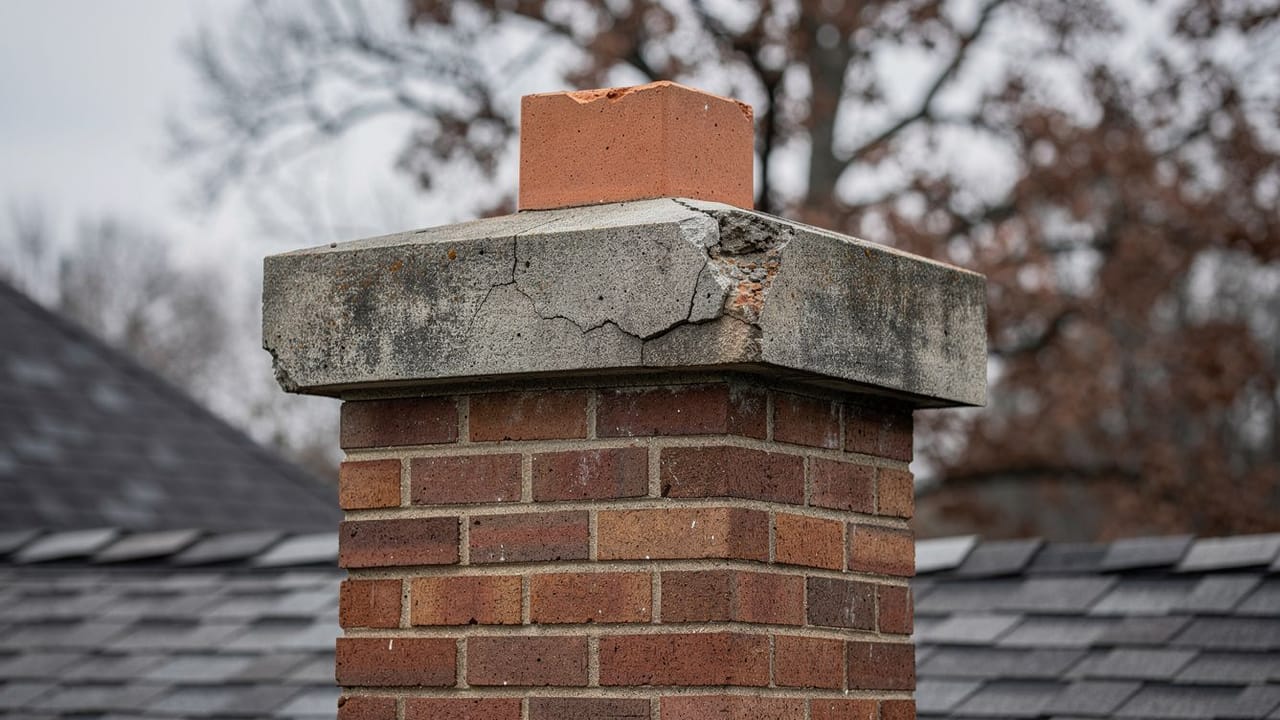
The crown is the slab across the top of a brick chimney, the part that keeps rain off the top of the masonry and sheds it past the faces. When it cracks, the water it was meant to stop runs down into the brick and the joints, and the trouble shows up later as loose mortar, a stained ceiling or brick faces popping off. Most of the chimney work on our chimney repair page begins with a look at this one piece. The question we are asked most is whether a cracked crown can be fixed in place or has to be replaced, and the answer depends less on the crack than on what the crown was built from and how much of it is left.
Can a cracked chimney crown be patched, or does it have to be replaced?
It can be coated when the crown is sound apart from its cracks, and it has to be replaced when it is not. The Chimney Safety Institute of America’s chimney crown guidance (2020) draws the line in about those terms. A coating is an option for a crown with some cracking, no missing pieces, a sound surface for the product to bond to, and correct, sound support underneath. Replacement is the answer once the crown is broken into fragments, has large pieces missing, or has a surface too weak to hold a coating.
On a roof, that comes down to a few plain checks. We press on the edges and tap across the slab: a crown that sounds hollow, flakes under a screwdriver or shifts at a crack is past coating. We look at where the cracks run, because a crack that opens from the flue tile to the edge often means the crown was poured tight against the tile, which is something a coating cannot change. And we look at what it is resting on, since a crown slumping over the flue opening is a support problem, not a surface one.
- Coat it: hairline cracks, nothing missing, a solid surface, sound support
- Recast it: broken pieces, missing chunks, a crumbling surface, or a crown sagging on poor support
Why do so many chimney crowns crack in the first place?
Most crack because they were never really crowns. The same CSIA material says that the majority of masonry chimneys do not have a proper crown, and that washes, splays and other poorly built tops tend to perform badly. A wash is a layer of mortar troweled over the top course of brick and feathered out toward the edges. Many older brick chimneys around Middle Tennessee were finished that way, and the faults CSIA lists are the ones we find on them: thin at the edges, the wrong material, packed hard against the flue tile, no drip edge, too flat to shed water and not supported correctly.
Once water gets in, the weather does the rest. CSIA describes water at the top of a chimney soaking the brick from both the top and the side, then freeze and thaw cycles washing out the joints and making the brick fail by spalling. Middle Tennessee winters swing above and below freezing night after night, which is the pattern that turns a hairline crack into an open one. The joint side of that damage is covered in why mortar fails before the brick does, and the face side in when brick faces start popping off.
What a crown we pour looks like
When a crown comes off, we take it down to sound brick, set support and a bond break, build forms around the top of the chimney and pour concrete. That is the replacement method in the CSIA guidance, and the shape it describes is the one we build to on our chimney crown and rebuild work. It calls for the crown to overhang the brick by 2 1/2 inches, to carry a drip edge 1 inch out from the chimney face so water falls clear instead of running back down the brick, to be 2 inches thick at its edge, and to slope 1 inch per foot away from the flue. These figures are CSIA’s guidance for a well-built crown, not a Tennessee code requirement.
Two details matter as much as the dimensions. CSIA calls for an expansion joint between the crown and the brick and a 3/8-inch expansion joint between the crown and the flue tile, because the flue heats and moves on its own and a crown bonded tight to it cracks from the inside out. For comparison, Wisconsin’s state building code, Wisconsin Administrative Code SPS 321.30(8)), writes a floor of its own for chimney caps: 2 inches thick, sloped away from the flue, with a 1-inch overhang and drip edge on all sides. That is one other state’s rule, shown only as an example of how a written minimum reads.
- Concrete, not a mortar wash
- 2 1/2-inch overhang with a drip edge 1 inch off the chimney face
- 2 inches thick at the edge, sloped 1 inch per foot
- Expansion joint at the brick, and 3/8 inch at the flue tile
Do caulk, coatings or a metal cover ever stand in for a new crown?
Caulk and tar do not, and the right coating can only extend a crown that is still sound. CSIA is blunt that crack repairs made with improper products such as tar or silicone sealant fail. The products that work are crown coatings: elastomeric, flexible ones that are brushed or troweled on, usually in two coats for the brush versions, and cementitious ones that need a bond break and typically have a limited life. Many crown coatings have to be applied at 45 degrees F or warmer, though some newer ones are made for colder days, so in our climate the coating jobs fit best into fall and spring. We tape the brick just below the crown so the coating stops in a clean line instead of smearing down the face.
A cap and a chase cover are the other tools. CSIA recommends an outside-mount chimney cap to protect the crown whatever repair is made, and treats a stainless steel or copper chase cover with a drip edge, set over the existing crown, as a workable option in many cases. Where the crown meets the roof, the flashing deserves the same look: the Mason Contractors Association of America’s brick brief on flashing chimneys lays out counterflashing lapping the base flashing by at least 3 inches, and warns against aluminum because fresh mortar attacks it. For the rest of what fails on a chimney, see what goes wrong with a brick chimney, and to have our mason look at yours, ask for a free estimate.
Sources
- Chimney Safety Institute of America, Chimney Crowns (Russ Dimmitt, HPBExpo Education, 2020) — Most chimneys lack a proper crown; how washes and splays fail; water and freeze-thaw damage; when to coat and when to replace; crown dimensions and expansion joints; tar and silicone fail; coating types and the 45 F application limit; caps and chase covers.
- Wisconsin Administrative Code SPS 321.30(8) — Another state’s code, cited as an example only: chimney caps 2 inches thick, sloped away from the flue, with a 1-inch overhang and drip edge.
- Mason Contractors Association of America, Brick Brief: Flashing Chimneys (2007) — Counterflashing laps base flashing at least 3 inches; aluminum flashing is attacked by fresh mortar.
FAQ
Cracked Chimney Crown: Coat It or Recast It? — questions
Can a cracked chimney crown be repaired or does it have to be replaced?
It depends on what is under the crack. A crown with hairline cracks, no missing pieces, a solid surface and sound support can take an elastomeric coating. One that is broken into pieces, missing chunks or crumbling at the surface has to come off and be poured again in concrete with an overhang and drip edge.
Can I fix a cracked chimney crown with caulk or silicone?
No. The Chimney Safety Institute of America’s crown guidance says crack repairs made with tar or silicone sealants fail. They do not bond to old mortar or concrete for long and cannot flex with the crown. A purpose-made crown coating on a sound crown, or a new poured crown, is the repair that lasts.
How thick should a chimney crown be and how far should it overhang?
The Chimney Safety Institute of America’s guidance calls for concrete 2 inches thick at the edge, a 2 1/2-inch overhang past the brick, a drip edge 1 inch out from the chimney face, a slope of 1 inch per foot, and expansion joints at the brick and a 3/8-inch one at the flue tile.
Can a metal chase cover go over an old chimney crown?
In many cases, yes. The Chimney Safety Institute of America treats a stainless steel or copper chase cover with a drip edge, installed over the existing crown, as a workable option. It sheds water past the brick the way a good crown would. We still check that the crown underneath is not crumbling into the flue.
Can I coat a chimney crown in cold weather?
Usually not in midwinter. Many crown coatings must go on at 45 degrees F or warmer, according to the Chimney Safety Institute of America, though a few newer products are made to work below freezing. In Middle Tennessee that makes fall and spring the practical window, before freeze and thaw cycles open the cracks wider.