
· by Michael Blair, Nashville's Masonry
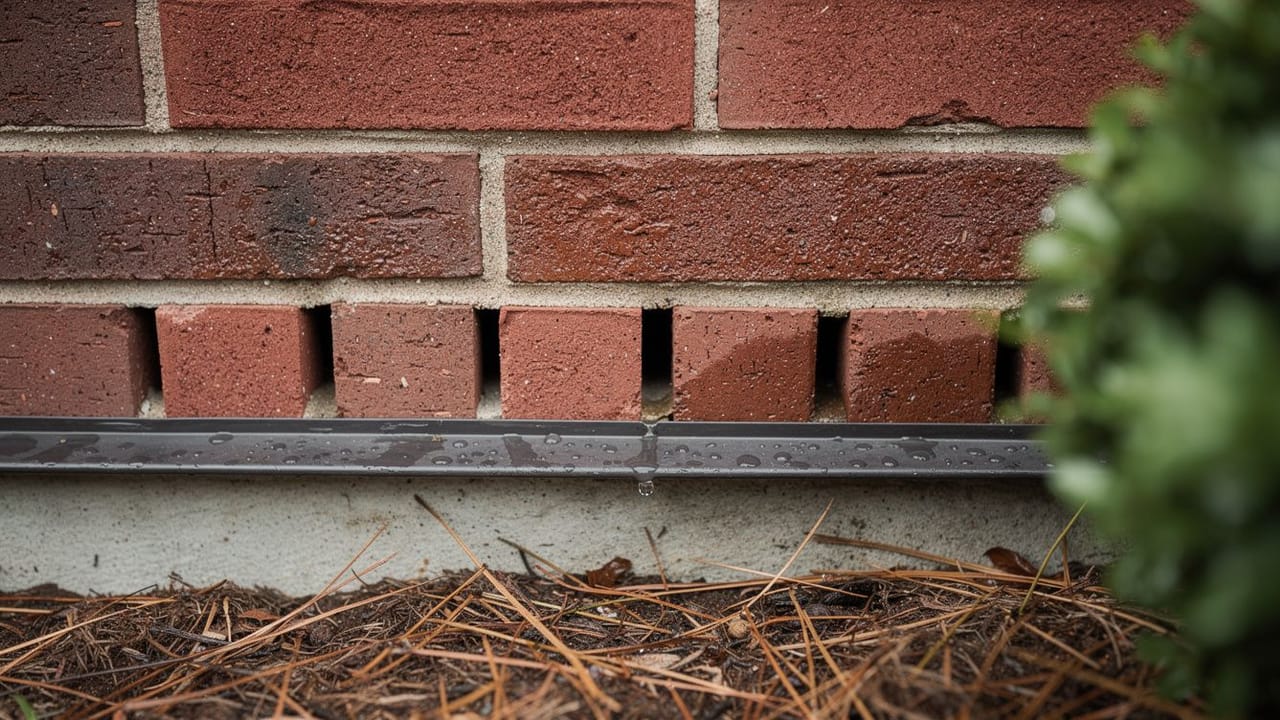
Brick veneer on a house is not waterproof and was never meant to be. The Building America Solution Center’s guide to flashing at the bottom of exterior walls, published for the Department of Energy, describes properly detailed brick veneer as a rain screen: water that seeps into the brick flows down the space behind it, is collected by through-wall flashing at the bottom of the wall, and drains out through weep holes. The open joints at the base of the wall and above windows and doors are the outlets of that system, and a weep hole someone has filled is an outlet that no longer works.
How a brick veneer wall drains
Behind the brick there should be an air space, which the same guide puts at 1 inch or more, and behind that a weather-resistive barrier lapped shingle fashion over the framed wall. Water that gets through the brick runs down its back face through that space. At the bottom, the flashing starts behind the barrier, runs out across the ledge the brick sits on and hangs down past the face, and the weeps in the bottom course let the water drip out onto it. The guide calls for weeps in the same places on every brick wall: at the base, above all window and door lintels, and above shelf angles.
The air space is also how the wall dries. According to the guide, it lets air move behind the brick, and venting behind brick and stone matters more than behind most claddings, because sun on wet brick can push vapor through it "with the force of a steam boiler." The gap gives that vapor somewhere to go before it reaches the framed wall.
What happens when weep holes are blocked?
Water still gets through the brick, but it can no longer drain out. The Solution Center guide is plain that water collecting on the through-wall flashing must be able to drain out through the weep holes. With them filled, it stays on the flashing, and that flashing laps the bottom of the sheathing, so the water is sitting at the base of the wood wall behind the brick.
Most of this happens out of sight. The guide notes that when the brick at the base of a wall is taken off, the sheathing behind it is sometimes found rotten, and then all of the rotten sheathing has to come out along with whatever let the water in. On a wall like this we start with the staining low on the brick and the condition of the weeps, and if the lower courses are also carrying white deposits, our post on efflorescence explains what that crust is telling you.
- Never caulk, mortar or foam a weep hole
- Keep mulch, soil and patio slabs below the bottom course
- Keep paint and the grit from cleaning out of the open joints
- Check that there are weeps above windows and doors, not just at the base
How do you keep bugs and mice out of weep holes?
Fit a screen that keeps them out and still drains, because weep holes are open joints and insects find them. The guide illustrates open head joints filled with an open-weave mesh and calls it a good idea for keeping mud wasps from nesting in the weeps and for stopping other obstructions from blocking the free flow of water. Homeowners ask us about mice as well, and our answer is the same as for wasps: a screen that fits the opening and still lets water through.
Purpose-made weep vents and mesh inserts that press into the joint from outside are what we usually fit. Whatever goes in, the test is whether water can still drain past it. Anything that stops it, including the foam backer rod people sometimes push into the joints, defeats the purpose. If the wall needs washing, our post on cleaning brick covers the pressure and the cleaners that do damage, and whichever you use, look along the bottom course afterward and make sure the open joints are still open.
Walls that never had them
Not every brick house has base flashing and weeps, and we find walls without them when we open up older houses. The Solution Center counts unflashed brick and stucco among the claddings that tend to cause the worst water damage, naming staining, leaks and freeze-thaw. A house built in Davidson County today is permitted under the codes on Metro Nashville’s adopted codes list, which includes the 2024 International Residential Code; an older one was built to whatever its builder and the rules of its day required, which is why we check rather than assume.
Drilling weeps into a wall like that does little on its own, because the system the guide describes depends on flashing to collect the water and lead it to them. Adding base flashing means removing the bottom of the cladding, which the guide says is most difficult with brick, since it has to be chipped out and replaced; when it goes back, weeps are added to the mortar joints, and the guide suggests it is a good time to repoint the base of the wall. That is brick repair and tuckpointing work rather than a drill-a-hole job.
Where the wall is not showing problems, the sensible course is the water management the Solution Center’s gutters and downspouts guide describes: grade sloping away from the house, and gutters and downspouts that carry roof water away from the foundation. We would add sound mortar to that list, and if you want us to look at the weeps, the flashing or the joints on your wall, ask for an estimate.
Sources
- DOE Building America Solution Center (PNNL), Flashing at Bottom of Exterior Walls — Brick veneer as a rain screen; through-wall flashing and weep holes; weeps at the base, above lintels and shelf angles; 1-inch air space; venting and drying; open-weave mesh against mud wasps; rotten sheathing found in retrofits; unflashed brick and the worst water damage; base flashing retrofit in brick, weeps and repointing
- DOE Building America Solution Center (PNNL), Gutters and Downspouts — Grade sloping away from the house and gutters protect the foundation from water
- Metro Nashville Codes Administration, Adopted Codes List — Metro Nashville has adopted the 2024 International Residential Code (BL2025-898)
FAQ
Weep Holes and Why You Should Not Fill Them — questions
What are the small holes at the bottom of my brick wall?
Weep holes. They are deliberate open joints in the mortar, left so that water which gets behind the brick can drain out over the flashing. They belong at the base of the wall and above windows and doors, and they need to stay open.
Can I fill weep holes to keep bugs out?
No. A filled weep holds water in the wall that was meant to drain out. Fit an open mesh insert or a purpose-made weep vent instead, which keeps insects from nesting in the joint while still letting water through.
Why is there water coming out of my brick weep holes?
Because they are doing their job. Rain that soaked into the brick ran down the back of it, landed on the flashing and is draining out. Water from the weeps during or after a heavy rain is what the system is built for. Water showing up inside the house, or staining that keeps spreading on the brick below the weeps, is the thing to have looked at.
Are weep holes required for brick veneer?
The Department of Energy’s Building America guide treats them as part of every brick veneer wall, calling for weeps at the base, above all window and door lintels and above shelf angles so the flashing behind the brick can drain. Older houses here sometimes have neither weeps nor base flashing, so we check each wall rather than assume.