
· by Michael Blair, Nashville's Masonry
Brick is a fired product with a smooth, glazed surface, and the National Park Service’s Preservation Brief 1 on cleaning masonry warns that abrasive methods can take that surface off and leave the masonry permanently damaged. What is left is rough, holds dirt and is harder to clean the next time. So we start every cleaning with the gentlest thing that might work, and only step up when it doesn’t.
Can pressure washing damage brick?
Water at too high a pressure, the kind used in power washing and water blasting, is abrasive enough to etch soft stone and some types of brick, according to the same brief. Mortar suffers too, lime mortar especially. The brief says abrasive and mechanical cleaning can erode the joints, which make up as much as 20 percent of a brick wall’s surface, and that eroded joints can let in more water and end in repointing. A second Park Service guide, Preservation Brief 39 on unwanted moisture in buildings, warns that high-pressure power washing can force water into construction joints, dislodge mortar and saturate the masonry. We look at the joints before we quote any cleaning, and open ones go on the list for repointing before water goes anywhere near them.
Brief 1’s recommended way to begin is a very low pressure, 100 psi or below, even a garden hose, stepping up only as needed and generally no higher than 300 to 400 psi. If a chemical cleaner is used, it dwells on the wall for the time the manufacturer recommends or, better, the time a test patch shows it needs. Gentle pressure does not make a cleaner safe, though: the brief warns that an acid cleaner left on too long or rinsed poorly can harm the masonry, and it calls for pH strips after rinsing to confirm the wall has been neutralized.
Timing matters too. The brief says no water cleaning should be done when frost or freezing is likely, because water inside the masonry can freeze and cause spalling and cracking, and it notes that a wall may take over a week to dry. Chemical cleaning should never happen below 40 degrees F, and generally not below 50. The rest of the season’s limits are in our post on masonry work as the weather turns cold.
What each problem needs
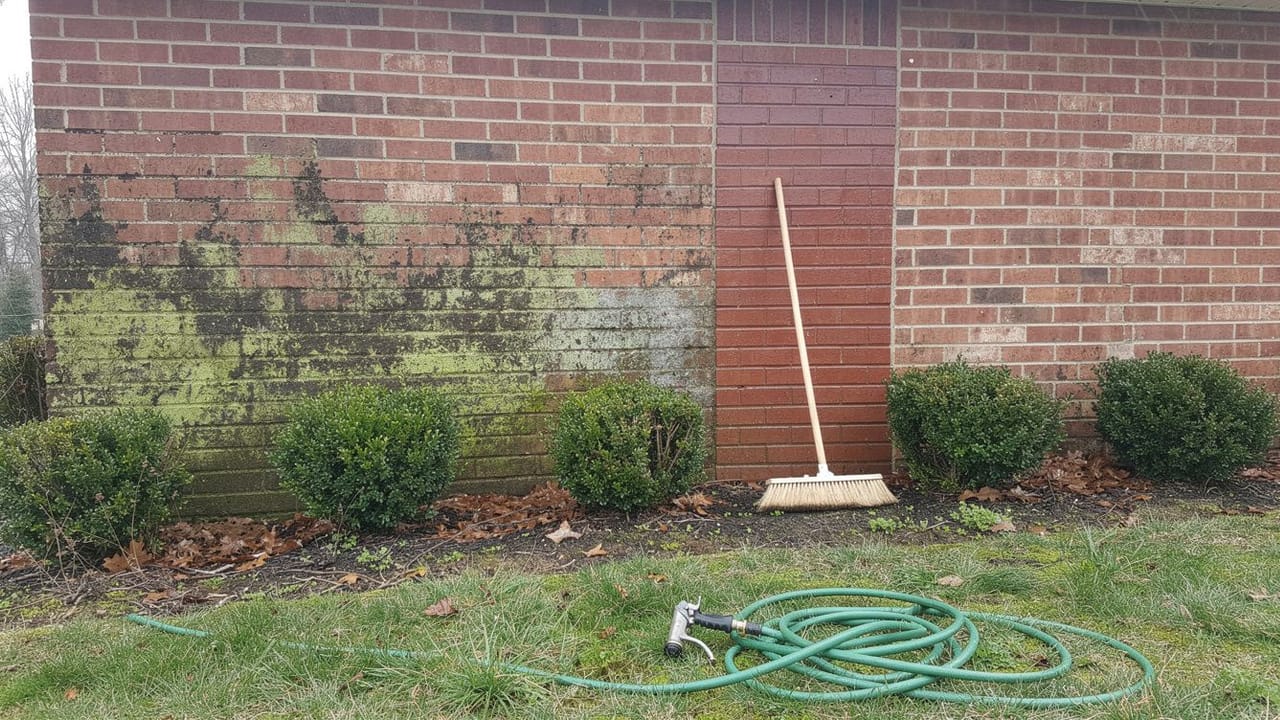
Green algae, mold and mildew show up where a wall stays damp, and Brief 39 lists mold and mildew among the common signs of moisture damage. For the growth itself, Brief 1 says a low-pressure water wash, possibly with a non-ionic detergent added, and scrubbing with a natural or synthetic bristle brush will usually remove it. Metal brushes are out, since the brief says they can abrade the surface and leave particles behind that stain.
Efflorescence, the white powdery bloom, is soluble salt that water carries to the face and leaves there as it evaporates, as Brief 1 describes it. The Brick Industry Association’s Technical Note 23A on efflorescence says a dry brush usually takes off whatever bloom the weather leaves behind, and Brief 39 calls for non-metallic bristle brushes. BIA also advises against washing it off except in warm, dry weather, because the added water can bring more salts out, and its first instruction is to correct the causes before attempting removal. Where the water is coming from is the subject of our post on white stains on brick.
- Start at 100 psi or below and step up only if needed
- Wet the wall first for acid and alkaline cleaners
- Test every cleaner on an inconspicuous spot first
- Efflorescence: dry brush with a non-metallic brush, then fix the moisture
- Never use hydrochloric (muriatic) acid on historic brick
Is muriatic acid safe to use on brick?
Muriatic acid is hydrochloric acid, and Brief 1 says it should not be used on historic masonry because it can dissolve lime-based mortar, damage brick and some stones, and leave chloride deposits on the wall. BIA’s note names hydrochloric acid used improperly in cleaning solutions as one source of chloride efflorescence, so a bad acid wash can leave a fresh white bloom behind.
The brief does allow that certain acid-based cleaners may be appropriate if used as directed on a particular type of masonry. Masonry is generally wetted first for both acid and alkaline cleaners, and an acid cleaner goes onto the pre-wet wall, stays wet while it works and is then washed off. Since the exact makeup of a brick or stone is not always clear, the brief says testing on an inconspicuous spot is always necessary, and BIA says the same about every cleaning solution. On a newer wall we use a cleaner that the brick or cleaner maker approves for that brick, tested first. On an older wall we leave muriatic acid out of it.
Paint on brick
Taking paint off brick is slow work. Brief 1 says paint and other coatings are best removed with alkaline paint removers, organic solvent removers or other cleaning compounds, applied by brush, roller or spray and then washed off thoroughly. Stains and graffiti that have soaked into the masonry often come out best with a poultice, and the brief admits it can take several different removers before the right one is found. Sandblasting and grinding are the ones to turn down: the brief calls abrasive methods generally not appropriate for historic masonry, because they take off the outer surface of the brick along with the paint.
Before any stripping starts, decide whether the paint should come off at all. The brief points out that many buildings were painted when they were built or shortly after, and that even where bare masonry is appropriate, keeping the paint may be more practical than removing it. If you are on the fence, book a free estimate and we’ll look at the wall with you before anything is stripped.
Sources
- National Park Service, Preservation Brief 1: Assessing Cleaning and Water-Repellent Treatments for Historic Masonry Buildings (2000) — Glazed surface of brick removed by abrasive methods; high-pressure water etches some brick; mortar joints up to 20 percent of a brick wall and eroded by abrasive cleaning; start at 100 psi or below, generally no higher than 300 to 400 psi; grit in the runoff means the pressure is too high; dwell time; pH strips; no water cleaning near frost, no chemical cleaning below 40 degrees F; biological growth removed with low-pressure water, non-ionic detergent and bristle brushes, never metal; efflorescence; wet first for acid and alkaline cleaners; test on an inconspicuous spot; no hydrochloric (muriatic) acid on historic masonry; paint removers and poultices; abrasive methods not appropriate; keeping paint may be more practical
- National Park Service, Preservation Brief 39: Holding the Line, Controlling Unwanted Moisture in Historic Buildings (1996) — High-pressure power washing forces water into joints and dislodges mortar; mold and mildew as signs of moisture damage; remove efflorescence with non-metallic bristle brushes
- Brick Industry Association, Technical Note 23A: Efflorescence, Causes and Prevention (2019) — Dry brushing removes efflorescence; wash only in warm, dry weather; correct the causes before removal; test all cleaning solutions on a small area; improper use of hydrochloric acid as a source of chloride efflorescence
FAQ
Cleaning Brick Without Damaging It — questions
Can I pressure wash brick?
At low pressure, yes. Start at 100 psi or below, even with a garden hose, keep the nozzle back from the wall, and go higher only if the dirt will not move, generally to no more than 300 to 400 psi. High pressure can etch some types of brick, erode lime mortar joints and drive water into the wall. If grains of stone or sand show up in the runoff on the ground, the pressure is too high.
What is the white powder on my brick?
Efflorescence: soluble salts carried to the surface by water moving through the masonry and left behind when it evaporates. Dry brushing with a natural or synthetic bristle brush usually takes it off, and washing it is best left to warm, dry weather. If it keeps reappearing, water is getting into the wall and staying there, so finding and stopping that water is the real repair.
How do I remove paint from brick?
With an alkaline or solvent paint remover suited to masonry, tested on a small hidden area first and washed off thoroughly, and a poultice for stains that have soaked in. Sandblasting, grinding and other abrasive methods take the surface of the brick off with the paint and damage it permanently. Full removal can take several products, so it is worth asking first whether keeping the paint is the more practical choice.
What should I use to clean brick?
Start with low-pressure water and a natural or synthetic bristle brush, adding a non-ionic detergent for algae, mold or mildew; metal brushes scratch the face and leave stains. Dry-brush efflorescence instead of washing it. Any chemical cleaner should be one approved for that brick, tested on a hidden spot first and applied to a pre-wetted wall.