
· by Michael Blair, Nashville's Masonry
We think manufactured stone veneer is a reasonable product with a worse reputation than it deserves, and the failures we get called to usually trace back to the installation rather than the stone. Coronado Stone Products’ installation guide says as much from the maker’s side: moisture penetration can be avoided with proper design and engineered systems. It is a cladding, not a waterproof layer, and what sits behind it is most of what we look at on our stone and veneer work.
It is not waterproof
Moisture moves through masonry, and the same Coronado guide explains the white bloom of efflorescence as moisture working through the stone to its face. So the wall behind needs its own protection. Where a water-resistive barrier is required, the guide has its inner layer, together with the flashings, form the drainage plane inside the wall. A separate rainscreen is another matter: the guide calls rainscreens optional and notes that some state and local codes require them behind manufactured stone, so the answer depends on the jurisdiction. In Davidson County that means the code Metro enforces, and Metro Codes’ adopted codes list shows the 2024 International Residential Code with local amendments.
When we look at a veneered wall, the first thing we want to know is whether there is any barrier behind the stone at all. Stone set straight onto bare sheathing leaves nothing between that moisture and the wood, which is why we check it before anything else.
The details that matter
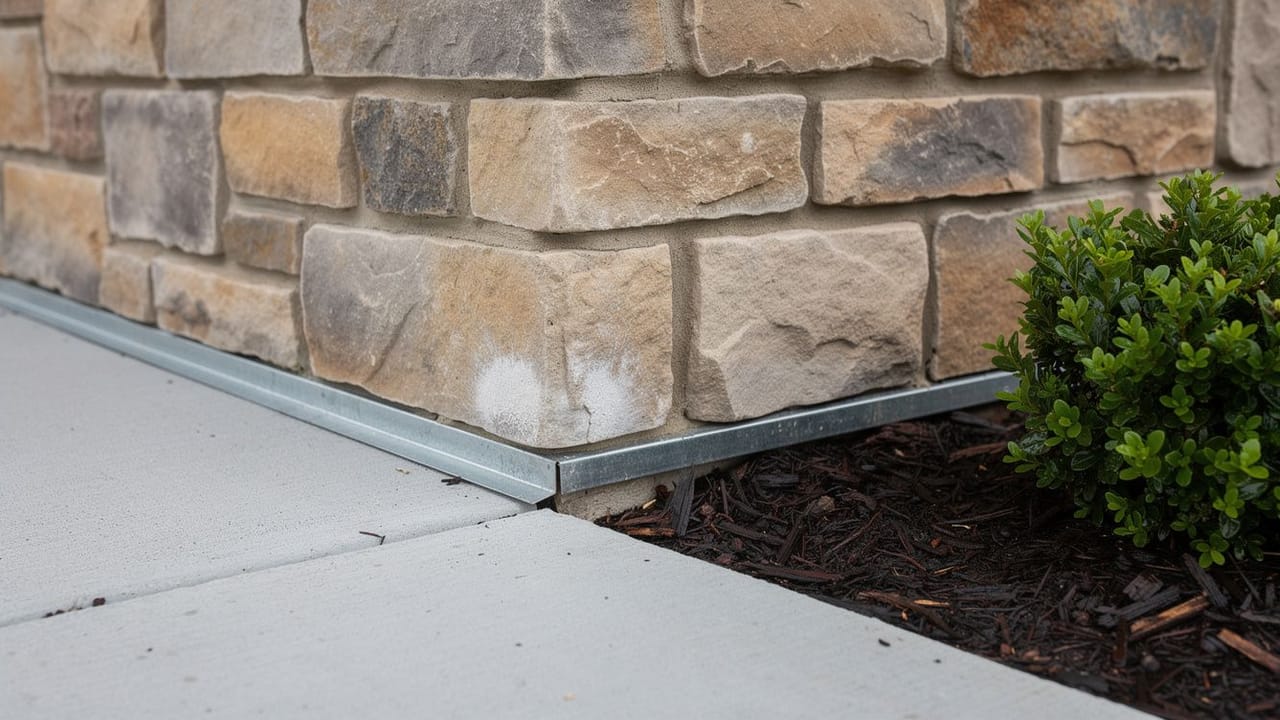
For a mortar-set system with a scratch coat, the guide calls for two separate layers of Grade D barrier, the outer one keeping the scratch coat off the inner one; over cement board its diagram shows a minimum of one layer. A weep screed runs along the base. Flashing, in the guide’s words, must be installed at wall penetrations and terminations of the stone veneer, and any kickouts have to be corrosion resistant and tied into the barrier.
On a framed wall, the guide puts the base flashing and weep screed at least 4 inches above grade or 2 inches above paved surfaces, with smaller figures over concrete or masonry and beside paving carried on the same foundation as the wall. Stone carried down into the dirt leaves no room for any of that. The screed does for veneer roughly what the gaps at the foot of a brick wall do, which our post on weep holes goes into.
- Water-resistive barrier behind the stone, two layers under a scratch coat
- Weep screed at the base, left clear
- Flashing at penetrations and wherever the veneer stops
- On framed walls, the base 4 inches above soil and 2 above paving
- Kickouts that are corrosion resistant and lapped into the barrier
What does stone veneer failure look like?
Efflorescence, which our post on white stains on brick explains, is the visible sign that water is moving through the stone. Beyond that we look for staining along the base, stones that have come loose, and sheathing that is soft once we open the wall. From the face alone there is no telling how long the wood behind has been wet.
A veneered wall running straight into the ground with no weep screed in sight is worth a closer look whatever the face looks like. Keep de-icing salt away from it in winter as well, since the guide says manufactured stone should not be in contact with de-icing materials, salt or harsh chemicals unless they are made for lightweight cement products.
How is stone veneer different from full stone?
Full-bed natural stone is laid as masonry, a wall in its own right, and how it is carried at the base is a structural question we settle before we price it. Manufactured veneer is a cladding adhered to the wall, and Coronado’s technical data sheet gives its shipping weight as less than 15 pounds per square foot.
Veneer is a legitimate choice when it goes on as a cladding with the barrier, base and flashing described above. The same data sheet’s advice holds for either kind: check the local building code before installing stone. If you would like us to look at the base and flashing on your wall, ask us for a free estimate.
Sources
- Coronado Stone Products, Standard Stone Installation Guide (2023) — Moisture penetration avoided by proper design; efflorescence as moisture moving through masonry; WRB where required and two Grade D layers under a scratch coat, one layer minimum over cement board; rainscreens optional, some codes require them; flashing at penetrations and terminations; kickouts corrosion resistant; weep screed 4 in above grade, 2 in above paving on framed walls; no de-icing salt
- Metro Nashville Codes Administration, Adopted Codes List — Metro enforces the 2024 International Residential Code with local amendments
- Coronado Stone Products, Technical Data sheet (2021) — Manufactured stone shipping weight under 15 lb per sq ft; check local building codes before installing stone
FAQ
Stone Veneer and Where It Goes Wrong — questions
Is manufactured stone veneer a bad product?
Not in our view. It is a cladding, and the trouble we see comes from what is missing behind it: the water-resistive barrier, the weep screed at the base, or the clearance above the ground. Coronado’s installation guide says moisture penetration can be avoided with proper design and engineered systems.
How can I tell if my stone veneer was installed correctly?
Start at the base. There should be a weep screed along the bottom, and on a framed wall Coronado’s guide puts it at least 4 inches above soil and 2 inches above paving. Veneer running straight into the ground with no screed is a sign that water has no planned way out, and it is worth having checked.
Can stone veneer be repaired?
We reset loose stones and rebuild small areas. A missing barrier or base detail is different, because it sits behind the stone, and putting it right means taking the veneer off that section. That is why we would rather inspect the base and flashing before problems appear than after.
Is stone veneer real stone?
Manufactured stone veneer is a lightweight cladding adhered to the wall rather than stone laid as masonry, and Coronado lists its shipping weight at under 15 pounds per square foot. Full-bed natural stone is a wall in its own right, carried on a base that has to be worked out structurally before we price it.